Can you visit Baikonur independently? Every workaround, honestly assessed

Open a map of southern Kazakhstan and the problem looks like a solved one. There is a rail line running east from the Aral Sea. There is a station on it called Tyuratam. Trains stop there from Almaty, Astana and Moscow, tickets cost very little, and nobody asks you for anything to buy one. A few kilometres away sits the oldest and busiest spaceport on Earth.
So the question that brings most people to this page is a reasonable one: why would anyone pay an operator for something that appears to be a train ride away?
The honest answer is that you can reach Baikonur on your own, and you cannot get inside it. The line between those two things is sharp, physical, and sits at a checkpoint on the road into town. What follows is every route around it that gets suggested online, and what each one actually delivers.
Start with what genuinely works
This part rarely gets written down, so it is worth being clear that independent travel here is not uniformly impossible.
You can get to Tyuratam. The station is outside the restricted zone. Trains run from Almaty, Astana and Moscow, no permit or special document is involved, and the ticket is an ordinary ticket. If your goal is to stand on the same rail line that has delivered every rocket this cosmodrome has ever flown, that is available to anyone with a passport and a timetable.
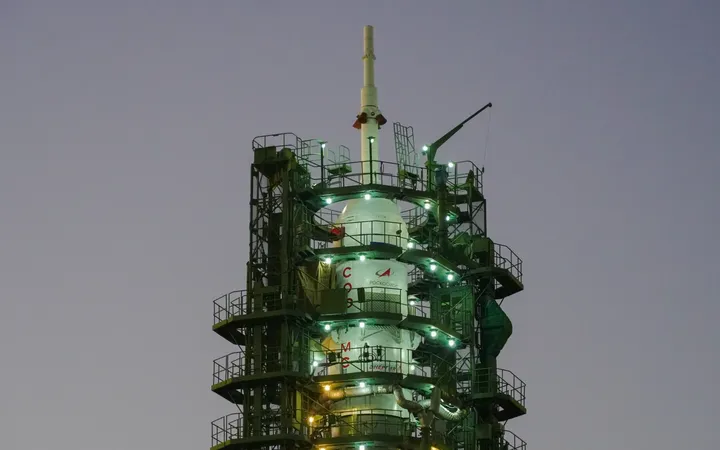
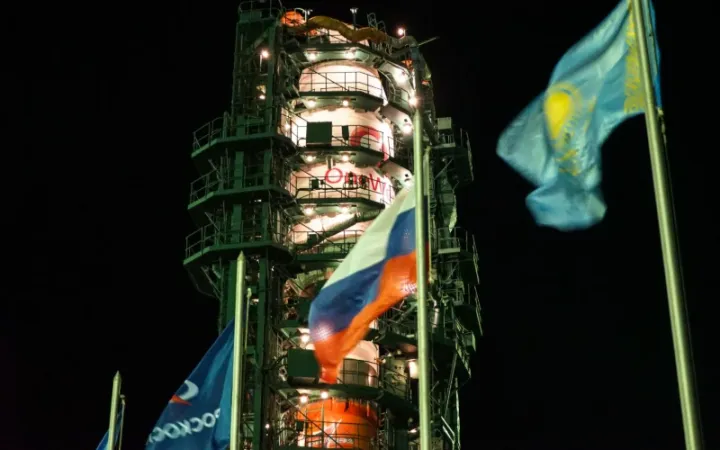
You can watch a launch from a distance. A Soyuz on the pad is roughly fifty metres tall and its exhaust plume is visible for tens of kilometres. From outside the closed zone, a launch is a real event in the sky, and people do go and watch it that way.
It is worth being precise about what that means, though. You will see light climbing out of the steppe, and some seconds later you will hear it. You will not see the rocket on the pad, the rollout, the service tower folding back, the crew walking out, or the viewing line. The gap is roughly the one between hearing a concert from the street and being at the concert.
You can look at the town from outside. Also true, and also limited — because everything worth looking at, from the museum to Gagarin's cottage to the launch complexes themselves, is on the inside.
Where it stops working
Everything below this line is a workaround people genuinely propose, and none of them do what they are believed to do.
"I'll apply for the permit myself"
There is no mechanism for it. A Baikonur permit application is filed by an accredited organisation, which simultaneously takes on responsibility for escorting the group inside the zone. Applications from private individuals are not processed — not because the fee is high or the queue is long, but because that procedure does not exist.
The same applies to getting a pass "through a contact" or "on arrival, with a passport." The checkpoint verifies a document that already exists. It does not issue one.
And note the plural throughout this series: a Baikonur trip needs two permits, one for the closed town and a separate one for the cosmodrome. Most guides compress this into "a pass", which is where a lot of independent planning quietly goes wrong. The full breakdown is in the permit article.
"The permits take ten days now, so it must have got easier"
This is the newest misconception and the most understandable one, so it deserves unpacking rather than dismissing.
On 9 June 2026, at a government meeting in Astana, Kazakhstan's Minister of Tourism and Sport Yerbol Myrzabossynov announced that the permit issuing period for foreign tourists had been cut from 1.5–2 months to up to ten days. The news is real, it was widely republished, and it is genuinely good news — it is also, at the time of writing, the single most out-of-date fact on every competing guide in this cluster.
But it describes how fast a document gets processed, not who may obtain one. The application is still filed by an accredited organisation. Ten days is a ceiling on the paperwork, not a change in who is allowed to do the paperwork.
And there is a second half to that announcement which the reposts almost never carry. The same briefing gave the capacity figures. The viewing platform holds 400 spectators per launch. The town has seven hotels and around 700 rooms. Over 11,000 people visited the complex in 2025, and more than 7,500 watched launches between January and June 2026 alone.
So the paperwork accelerated and the platform did not grow. The binding constraint moved off the documents and onto the physical seat count — which, for someone hoping to simply turn up, is worse news rather than better.
"I'll book a hotel in Baikonur and go"
A reservation confers no right to be in the town. The town permit is a separate document, checked at the checkpoint on the way in, long before any hotel is involved. In that situation a paid room is simply a paid room.
"I'm a Kazakh citizen, so it's simpler for me"
It is not. The procedure is identical: an application through an accredited organisation. Living twenty minutes from the station changes nothing about it. Baikonur is a closed city with a restricted-access regime, and the regime does not vary by the passport of the person arriving. What varies is the filing deadline, not the requirement.
The mirror image of this trips up foreign visitors, and it is worth stating plainly:
Kazakhstan is visa-free for around 56 countries, including the US, UK, Canada, Australia and every EU member, for up to 30 days per entry. Entering the country is genuinely easy. That allowance gets you to Kyzylorda, to Tyuratam, to the checkpoint — and no further. Easy entry to Kazakhstan and access to Baikonur are two unrelated questions, and conflating them is the most common planning error English-speaking travellers make here.
"I'll tag along with a group that's going"
Groups are formed against an application listing specific people and their passport details. Joining one on site is not possible: if you are not on the filed list, you cannot be inside the zone. There is no gate at which this gets negotiated.
What is actually behind the checkpoint
Put as a list, here is what no independent traveller can reach:
- the cosmodrome grounds, in their entirety;
- the viewing platform on launch day;
- the rocket rollout and the service tower;
- the Museum of the History of the Cosmodrome, and Gagarin's cottage;
- Gagarin's Start — Site No. 1, where Sputnik and Gagarin both departed;
- the assembly-and-fuelling building housing the two Buran orbiters;
- the Energia dynamic test stand;
- the crew walk-out and the Cosmonauts' Alley on a crewed launch;
- photo and video permission — on a restricted site the default is the opposite;
- ground transport inside the zone, and an escort.
The last two are the most consistently underestimated. Even a visitor holding both permits does not move around the site independently: it is a working, restricted facility, and group movement is organised rather than free.
What the legal route costs
Worth naming the numbers, because expectations usually sit well above them.
€900 buys three days in the inter-launch period. It is the cheap option, and it delivers more of the cosmodrome itself than a launch trip does: the museum, Gagarin's gazebo, Gagarin's Start, the Buran orbiters, the Energia stand. No launch — but also no fixed date to defend and no exposure to a slip. It runs year-round.
From €1,750 buys the launch programme: three to six days, with a launch.
Both include accommodation, a guide throughout, museum admission, the spaceport pass, photo and video permission, daily breakfast and all ground transport inside the zone. Neither includes travel to Kazakhstan, which is the largest line item outside the tour and worth budgeting separately —
realistically a flight to Almaty or Astana, then a connection to Kyzylorda (KZO), about 240–255 km from Baikonur.
If the original goal was to save money, the honest conclusion is this: the €900 inter-launch trip is the budget way into Baikonur. Nothing legal comes in below it, because what you are buying is the permit, not the logistics. Full pricing sits in the cost breakdown.
So should you go independently?
Yes — if what you want is to stand in the steppe, watch light climb out of the horizon and know you were nearby. That is real, it is legal, and it costs almost nothing.
No — if what you want is the cosmodrome. Everything people actually travel here for sits behind that checkpoint, and there is no route around it. Not because someone closed a loophole, but because an operational spaceport remains a restricted facility, and it is going to stay one.
How the trip works end to end is in the full guide. Documents and deadlines are in the permit article. Dates are in the launch schedule.
Programmes: the inter-launch trip at €900, and a Baikonur launch from €1,750.