
Baikonur launch schedule 2026–2027: every date, and how to be there

Baikonur launches something in most months of the year, so what makes 2027 worth planning around is not the count — it is the mix. Four cargo runs spaced evenly across the calendar. A Proton that will be among the last of its kind ever to leave a pad. And, in March, people.
Here is the calendar as it stands, what each date actually offers a visitor, and how to choose.
The 2027 calendar
- February–March 2027 — zero-gravity flight, Chkalovsky airfield near Moscow. Not a launch to watch — a flight you are on.
- March 2027 — Progress cargo, Baikonur. Uncrewed resupply from Site 31.
- March 2027 — crewed Soyuz, Baikonur. The date everybody asks for.
- April 2027 — cosmonaut landing, Kazakh steppe near Zhezkazgan. An ISS crew comes home.
- June 2027 — Progress cargo, Baikonur.
- July–September 2027 — Proton-M, Baikonur. Among the last Protons ever to fly.
- September 2027 — Progress cargo, Baikonur.
- December 2027 — Progress cargo, Baikonur.
- 2027, date to be set — Angara-A5, Vostochny.
- 2027, rolling windows — heavy Long March, Wenchang, Hainan.
Remaining 2026 dates:
- September 24 — Zero-gravity flight, Chkalovsky Airfield.
- November 19 — “KA ‘KOEN’/‘Kinosputnik’,” Vostochny.
- November 24 — “Progress,” Baikonur.
March 2027 is the densest month of the year
Read that list twice and one thing stands out: four of the ten entries fall in or touch March 2027. A crew comes home from orbit, a zero-gravity flight goes up outside Moscow, a Progress cargorocket leaves Site 31 on the 3rd, and another crew leaves the planet — all inside roughly four weeks. Nothing else in the year comes close.
Two consequences. If you have ever wanted to see two of these things on one trip, that is where to look, and it is worth asking early whether any two can actually be combined once dates firm up. And the less comfortable one: March 2027 is a little over half a year out, which is a short runway for a crewed date — not because of paperwork, but because the viewing platform holds 400 people per launch.
Four cargo launches: the backbone of the year
March, June, September and December are the most useful dates on the calendar and the most consistently overlooked.
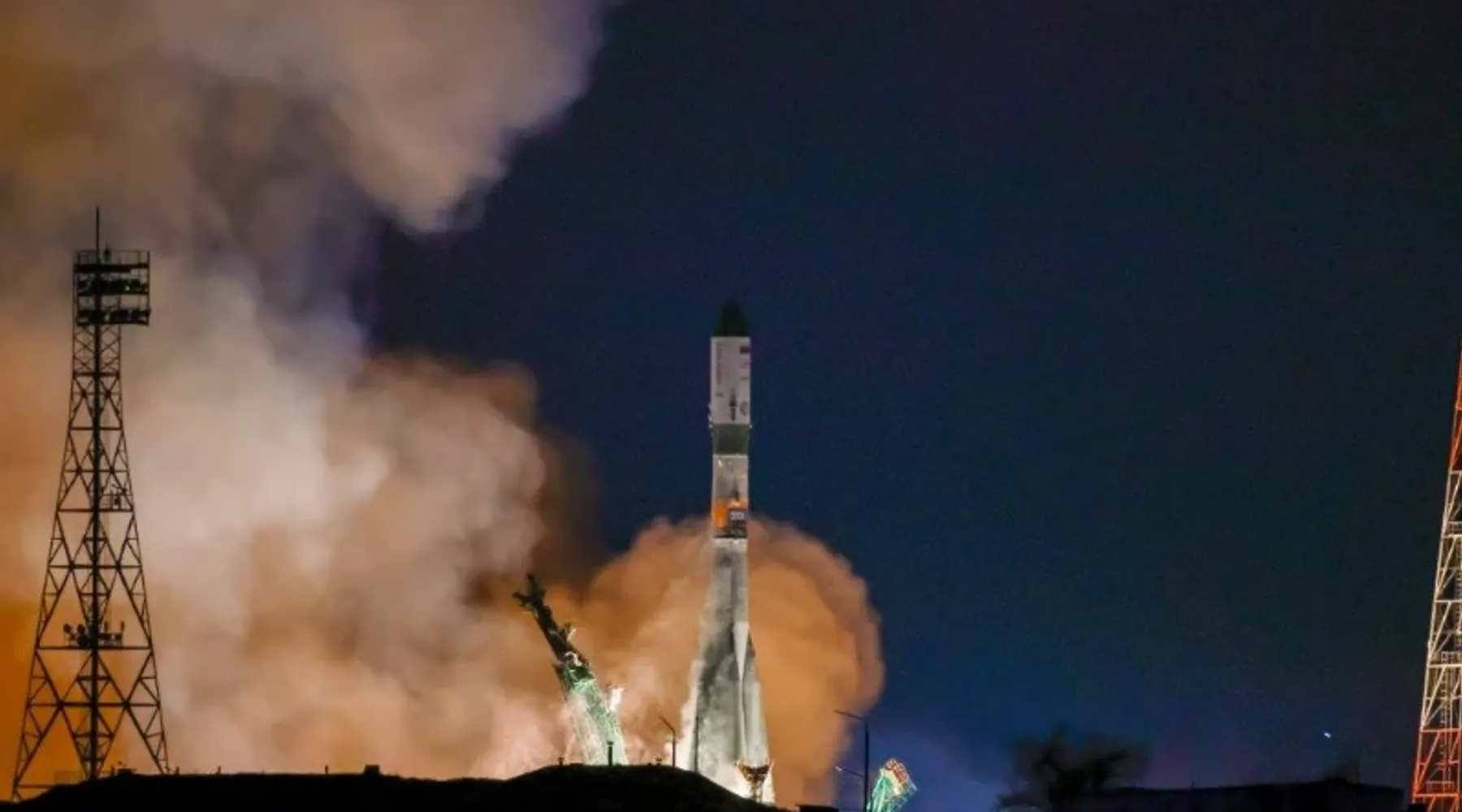
Nobody is aboard a Progress, which is exactly what makes it a good first launch. The choreography is the same: the rollout across the steppe at walking pace, the service structure closing around the vehicle, the pad clearing, the ignition you feel in your chest a beat before you hear it. What changes is everything around the launch — less contested dates, a calmer programme, and a town not simultaneously hosting an international press corps.
They also fall almost exactly one per quarter. Whatever your year looks like, one of them is probably reachable.
The Baikonur launch expedition runs three to six days from €1,750, with viewing from the accredited line at Site 31.
July to September: one of the last Protons
Proton first flew in 1965, has launched more than 400 times, and carried most of the heavy Soviet and Russian payloads of the space age. It is now down to a handful of flights as Angara takes over. February 2026 saw the final Proton-M fly with the Blok DM-03 upper stage.
For a visitor it is a different rocket in every sense that matters. Proton flies from its own pads — Site 81 or Site 200 — well away from the Soyuz complex. It burns hypergolic propellant rather than kerosene and oxygen, so it lights instantly, with no ignition sequence to watch, and leaves an amber-tinted plume no Soyuz ever produces.
The trade-off is the window: July to September is a three-month bracket, not a date, so this is the 2027 launch that asks for real flexibility. Once it stops flying there is no second chance.
March: the crewed Soyuz
A crewed launch is a different event, and not only because of what sits on top of the rocket. The days before it are full of ceremony that exists nowhere else: the crew's pre-flight press conference held behind glass because they are already in medical quarantine, the walk-out from the cosmonaut hotel, the tree each rookie plants on Cosmonauts' Alley, the flag-raising. Then the countdown, and three people
leaving the planet from Site 31.
The window is fixed to the second, because the target — a station already in orbit — will not wait. The pad has to pass under the station's orbital plane, and that constraint does not negotiate. Everything softer around it does: weather at the pad, upper-level winds, range availability.
Crewed dates are the most competitive on the calendar. Permits, transport and roughly 700 hotel rooms are consumed by one event at once. Of every date here, ask about this one first.
Beyond Baikonur
Vostochny, Angara, some time in 2027. Russia's newest cosmodrome, cut into the Amur taiga rather than laid out on steppe. Angara-A5 first flew from there in April 2024; Roscosmos has set 2027 for the upgraded A5M, with timing tied to modernisation of the launch complex rather than a published date.
Expect the specific day late. Note that Vostochny is on **Russian** territory — unlike Baikonur, it needs a Russian visa. Vostochny expedition, four days from €2,000.
The two dates that are not launches
A cosmonaut landing, April. The descent capsule comes down in the Kazakh steppe roughly 147 km southeast of Zhezkazgan. The most emotional date on the calendar for a simple reason: everywhere else you watch people leave; here you watch them arrive. Landing safari, three days from €2,000, eight guests maximum.
Zero gravity, February or March.** The Il-76 MDK from Chkalovsky — the aircraft cosmonauts train in. One day, ten parabolas of 25–28 seconds. Zero-gravity flight, €6,800.
Baikonur between launches: every month of the year
You do not need a launch. Between launches the closed zone opens wider and moves slower, because nothing is being counted down.
Three days covers the Museum of the History of the Baikonur Cosmodrome and City, Gagarin's gazebo on the Syr Darya, Gagarin's Start, the hangar holding two Soviet Buran shuttles, and the Energia dynamic test stand. No date to hold, nothing to slip, no competition for rooms. €1,000, year round.
For a first visit — or for a group — the inter-launch tour is very often the better trip, and the easiest to build a corporate programme around precisely because it is not hostage to a countdown.
How to choose
- You want people on the rocket → March 2027. Ask first; it fills first, and it is the nearest date here.
- You want the most reliable trip → a Progress date: March, June, September, December.
- You want a rocket that will not exist much longer → the Proton window, July to September, with flexibility.
- You want no date risk at all → Baikonur between launches, any month.
- You want the one that stays with you → the landing, April.
- You want two things on one trip → March, and talk to us now.
Good to know
Permits and deadlines: [the Baikonur permit explained. What the trip really costs, travel included: Baikonur tour cost. The whole trip end to end: how to see a rocket launch at Baikonur.
Tell us which launch you want to be standing under, and we will check what is genuinely open.